Harvested Insights
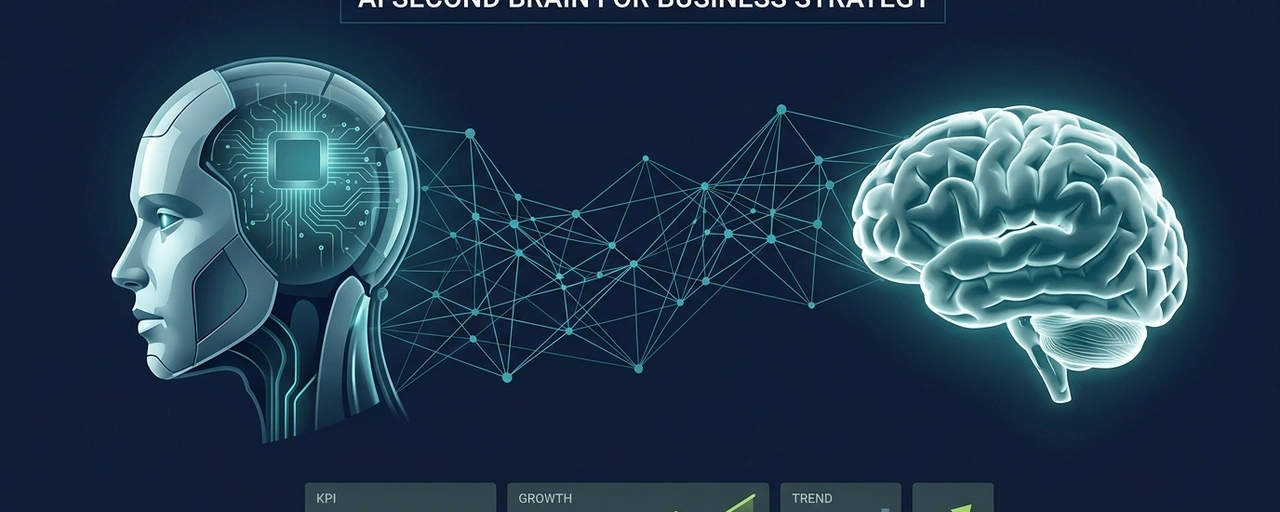
Give Your AI a Second Brain
The amnesia problem
It's Monday morning. You ask your AI assistant for a status update on the pricing decision you made three weeks ago, in a conversation that has since been closed. It draws a blank. It doesn't know your name, your products, your customers, or the direction you agreed on. It asks you to explain your own business back to you, from scratch.
Every conversation starts from zero. Close the chat window and the intelligence evaporates. Open it again and you're back to explaining your business to a very smart stranger.
That's not a small annoyance. It's the difference between a tool and a colleague.
A tool executes a task. A colleague holds context — knows your business, remembers last month's decisions, and gets better at working with you the longer you work together. Most AI today behaves like a brilliant contractor who turns up fresh every morning, introduces themselves, and asks you to re-explain the whole project. It may be the smartest person in the room, but it has the memory of a goldfish.
This article is about the architecture that fixes that: giving your AI a second brain.
What a second brain actually is
The term comes from Tiago Forté, whose book Building a Second Brain made the case that human working memory is a bottleneck. His line is famous for a reason: "our brains are for having ideas, not storing them." Forté's answer was an external, centralised digital repository — notes, insights, decisions, and the sources behind them — organised with a method he calls CODE (Capture, Organize, Distill, Express) and structured with PARA (Projects, Areas, Resources, Archive). The promise: you stop re-learning what you already knew, and information becomes output instead of decaying in your head.
Most business owners already have a second brain — it's just fragmented and manual. Your CRM, your filing, your staff's institutional knowledge, the "way we do things here" — that's the company's memory today. The problem is it's scattered across systems, maintained by hand, and it walks out the door when people leave.
Now apply the same idea to AI.
The second brain in AI
In AI, a second brain maps onto three things that persist beyond a single conversation:
Persistent memory. The agent keeps durable facts — your preferences, your environment, your decisions, lessons learned — across sessions, instead of starting blank every time. Hermes, the agent framework we build on, implements exactly this: a MEMORY.md for the agent's operational notes and a USER.md profile, injected into the system prompt at session start and managed by the agent itself.
Retrieval. Domain knowledge stored outside the model, fetched on demand. The academic term is Retrieval-Augmented Generation (RAG), and the survey by Gao et al. (arXiv:2312.10997) is clear about why it matters: RAG grounds answers in external, current, domain-specific sources, attacking the two biggest failure modes of large language models — hallucination and outdated knowledge. For a manufacturer or distributor, that means the agent answers from your SOPs, price lists, and history, not from general internet knowledge.
Agentic memory and skills. The research frontier treats memory as an architectural tier, not an afterthought. MemGPT borrows the operating-system metaphor — virtual context management that moves data between fast and slow memory, so the model's finite context window behaves like a much larger store. And skills are the "distill and express" half of CODE automated: procedures the agent saves after learning how to do something once, so it doesn't re-derive the method every time.
One line for a business owner: a second brain is externalised memory — for a human, a notes system you curate; for an AI agent, memory, retrieval, and skills that persist between conversations and compound over time.
Why memory makes agents measurably better
This isn't vibe. There's published evidence, and the numbers are concrete.
Continuity kills the blank slate. A stateless chat starts from zero every Monday. An agent with persistent memory walks into the conversation already knowing the client, the business, the decisions made last month, and the standing constraints. Hermes' documentation describes memory providers that go further — prefetching relevant memories before each turn and syncing conversation turns after each response.
Retrieval puts the right knowledge at the right moment. Instead of stuffing everything into a prompt, RAG retrieves the relevant slice on demand. The survey evidence shows this directly reduces hallucination and rework — the agent answers from your sources, not from guesses.
Skill accumulation compounds capability. The strongest demonstration is Voyager, an LLM agent that maintains an ever-growing skill library of executable code. The results: 3.3× more unique items, 2.3× longer exploration, and tech-tree milestones unlocked up to 15.3× faster than prior state-of-the-art — and the skill library transferred to a new world to solve novel tasks from scratch. And in the production world of agent harnesses like Hermes, this isn't just a research result: memory platforms built for agents — Hindsight, which describes itself as state-of-the-art on memory for AI agents and is supported natively by Hermes — make skill and knowledge accumulation the default operating mode, not an experiment.
Reflexion proves the self-correction loop. The Reflexion paper showed agents that verbally reflect on task feedback and maintain their own reflective text in an episodic memory buffer — no weight updates, just accumulated reflection — reaching 91% pass@1 on HumanEval, beating GPT-4's 80% baseline. Learning without retraining: memory does the work. This is precisely the retain-recall-reflect loop that production memory layers such as Hindsight implement for Hermes agents — the same self-correction behaviour, running every day in real operations, not just in a benchmark.
The business consequence is simple: less review-and-redo. The agent stops making the mistakes it already made once and learned from. And because it holds the context, the standing guardrails, and the playbooks, it can be trusted with longer, higher-order tasks — the difference between "run this one query" and "run this recurring operation on my behalf."
Less review-and-redo. The agent stops making the mistakes it already made once and learned from.
"Run this recurring operation on my behalf." — that is the shift from a tool to a colleague.
Better on day 30 than day 1
This is exactly the claim behind Hermes — an autonomous agent that gets more capable the longer it runs — and it rests on precisely these second-brain mechanisms:
- It knows the business. Persistent memory and knowledge bundles mean the agent holds your strategy, brand, playbooks, and decisions — not generic knowledge.
- It remembers decisions. Past sessions and their rationales stay accessible, so it doesn't contradict last week's direction.
- It improves its own playbooks. Skills get created, used, and patched during use — our own agents build and refine procedures as they become clearer.
- It compounds. Each interaction adds to the model of the user and the business. Honcho, one of the memory providers Hermes supports, describes memory that accumulates into "a deepening understanding that goes beyond what the user explicitly stated."
- It self-corrects. Reflexion-style loops retain reflected failures and inform the next attempt — the difference between an agent that repeats mistakes and one that learns.
We see this daily, in our own operations. Our agent crew persists decisions in memory, accumulates skills for recurring work, and self-corrects after failures — each task run leaves the next one better. Our forward-deployed engineering engagements document long-term agent memory management: goals, processes, and steps captured so the agent holds the context it needs, not just a one-off task. And our memory-management playbook treats this as engineering: memory is curated, consolidated, and gated — because a second brain that isn't curated becomes noise.
Our AaaS page says it plainly: an agent with "a second brain that knows your areas cold" is "better on day 30 than on day 1." This article is the engineering behind that sentence.
The honest limits
Now the part that protects your credibility — and ours.
The model itself doesn't improve. The underlying weights are static. The gains come from memory, skills, and retrieval. Anyone who tells you the model itself gets smarter is selling something.
Memory needs curation. Unmanaged memory decays into noise and contradiction. Forté's PARA discipline exists for a reason; our own playbook enforces consolidation, write-approval gates, and a watchdog. A second brain requires hygiene — it's a discipline, not a feature toggle.
Garbage in, garbage out. A second brain full of bad process, outdated prices, or unverified "facts" makes the agent confidently wrong. The quality of the memory is the quality of the agent.
Retrieval quality matters more than quantity. Retrieval that returns the wrong slice is worse than no retrieval. This is why RAG is an engineering discipline, not a checkbox.
Not a substitute for humans. A second brain makes an agent a better assistant and operator. Decisions, judgement, and accountability stay with the owner. Nostics' position is augmentation, not replacement.
The question for business owners
When you evaluate AI — any AI — stop asking "which model is smartest?" The smarter question is: "Does it remember my business, my decisions, and my way of working — and does it learn from its own mistakes?"
Memory, retrieval, and skills are what turn a clever chatbot into a compounding colleague. That's the architecture inside ISAaaS — Industry Solutions with Agents as a Service — and inside our forward-deployed engineering engagements: an agent layer that holds your context, applies your playbooks, and gets better the longer it runs.
The tool starts at zero every time. The colleague shows up on day 30 knowing more than it did on day 1. The difference is a second brain.
Start Diagnostic → — and let's find out what your company looks like with an AI that remembers.
Questions? Email us at hello@nostics.biz.