Harvested Insights
Information Waste: Impacting Your Factory
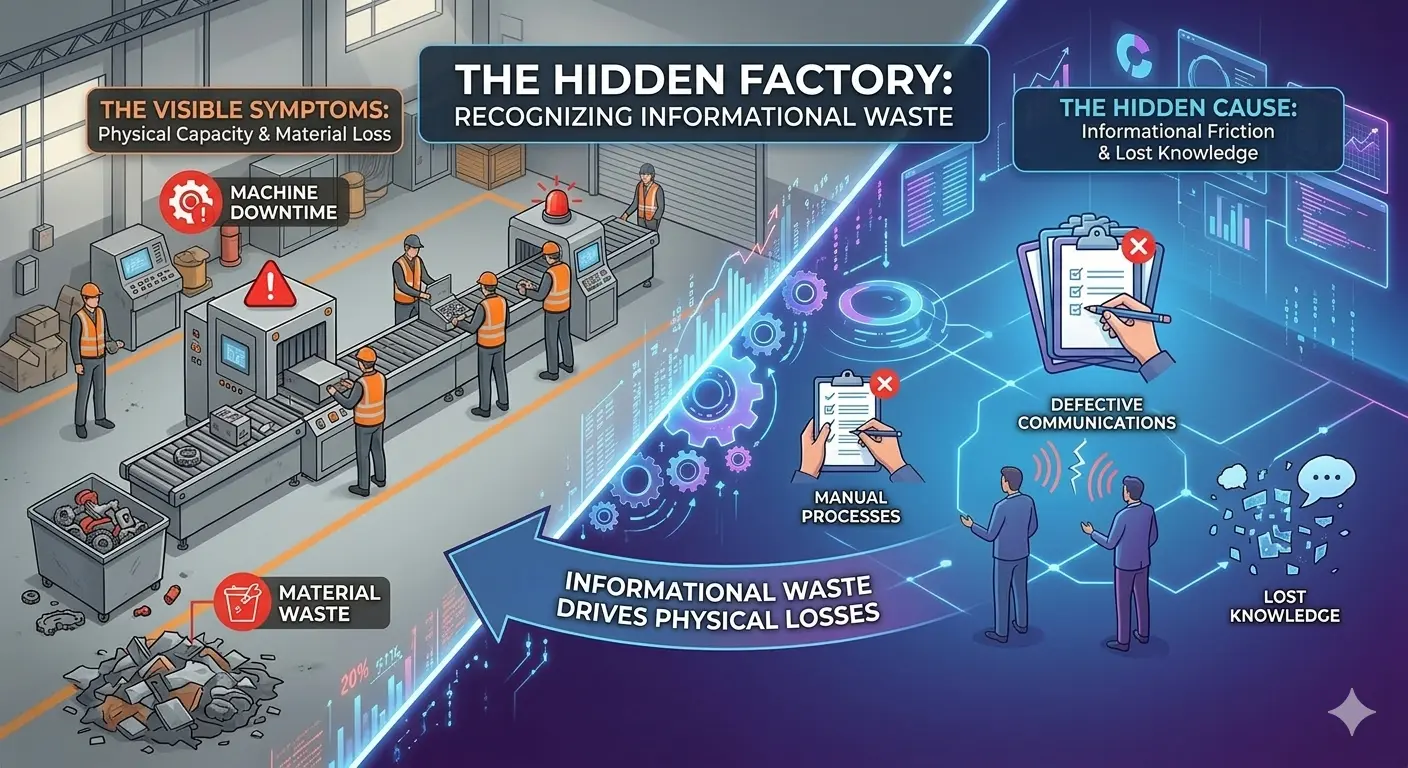
In a ResearchGate article by Valentin Grecu titled "The Hidden Factory: Quantifying Informational Waste and Operational Capacity Loss in Manufacturing," the staggering losses incurred by typical light industrial businesses in Romania are documented — losses in areas such as machine availability (25% of planned time), reliability, maintenance, quality of work, resource usage (20% material consumption lost), and global efficiency (25%). He further finds that the primary barriers to employee-generated solutions are mainly material support and resource allocation.
The Shift to Information Waste
During his study of such industry losses, Grecu found that our understanding of losses really has to shift to what he calls "Information Waste." He postulates that the overwhelming dominance of information friction — defective communications, manual processes, and lost knowledge — overwhelms the physical losses as the primary reason they happen.
Why Physical Losses Are Symptoms, Not Causes
The conventional view treats downtime, scrap, and rework as standalone problems. Grecu's research reframes these as downstream consequences of information failures:
- Defective communications cause misalignment between shifts, teams, and management.
- Manual processes introduce delays and errors that compound across the value chain.
- Lost knowledge means every personnel change resets institutional memory, forcing teams to relearn what was already known.
Local Relevance: Lessons from South African Industry
The article's findings resonate beyond Romanian manufacturing. In adjacent South African mining, similar patterns hold — where information silos, fragmented reporting, and knowledge loss drive operational inefficiency that far exceeds the visible physical waste on the shop floor or in the pit.
The takeaway for any operational leader is clear: before investing in another physical improvement programme, examine how information flows through your organisation. Fixing information waste is the highest-leverage intervention available.