Harvested Insights
The End of the Pyramid: Why the World's Smartest Founders are Shifting to "Dorsey Mode"
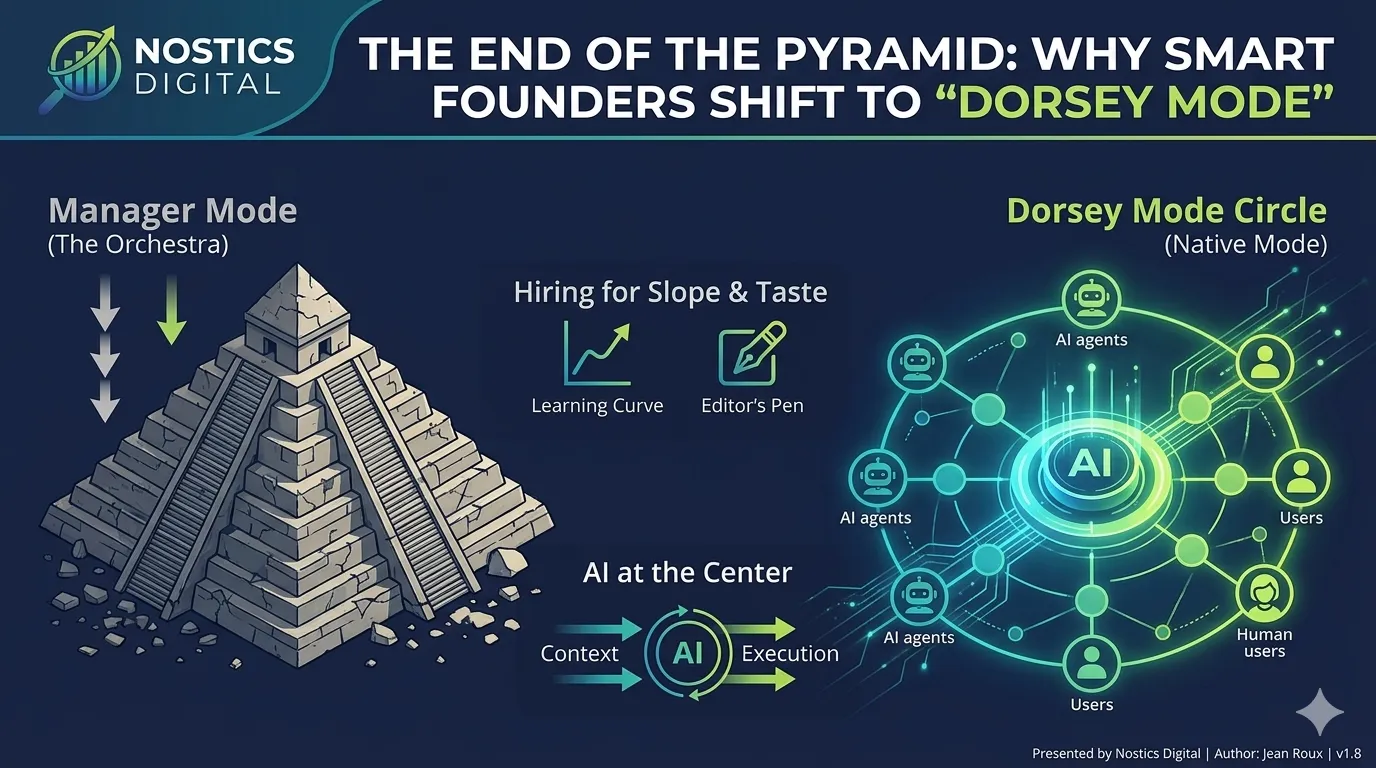
There is a profound, almost absurd irony at the heart of Silicon Valley. We build tools that execute in nanoseconds, yet we organize the humans who build them using a structural logic that dates back to the Roman Empire. We have spent decades plugging hyper-productive individuals into an archaic, hierarchical grid—a relic of the census and the legion—and wondering why organizational velocity hasn't kept pace with Moore's Law.
Brian Halligan, co-founder of HubSpot and partner at Sequoia Capital, argues that we are witnessing the final days of this anachronism. We are moving past the top-down "Manager Mode" and even the hands-on "Founder Mode" into a seismic new era: Dorsey Mode (or Native Mode). This is not a marginal update to the management playbook; it is a total demolition of the corporate pyramid in favor of a structure designed for the age of intelligence.
Takeaway 1: From the Orchestra to the AI-Generated Track
To understand this transition, Halligan's music metaphor reveals a startling truth about the evolution of control:
- Manager Mode (The Orchestra): The Jack Welch era. A massive pyramid where the CEO is the conductor. Every "violinist" and "cellist" has a rigid seat, and the output is strictly top-down.
- Founder Mode (The Jazz Band): The Steve Jobs/Paul Graham model. A five-piece jazz band that is loose, free-flowing, and comfortable with the leader changing their mind mid-performance.
- Dorsey Mode (The Suno AI App): This is the future. In "Native Mode," leadership is akin to using an AI music app. You feed the system massive amounts of context, the system generates the track, and the leader applies "taste and judgment" to edit the output until it is perfect.
In Dorsey Mode, the CEO's job isn't to conduct the players; it is to provide the "context and taste" to a system that generates the work. As Halligan notes, most companies claim to be "AI-native," but they are merely making individuals faster while the organization itself remains a Roman relic.
Takeaway 2: The Death of the Pyramid (The Circular Org Chart)
The triangle-shaped org chart was designed to move information up and down a human chain. Dorsey Mode replaces that triangle with a circle.
In this model, AI sits at the center of the organization. The primary role of the human workforce is to feed this center as much context as possible—strategy, data, and external connectors. But there is a technical catch: for this to work, the culture must be legible.
To move into Native Mode, a company must transition from a human-friendly culture to one that is agent-friendly. Systems and processes must be machine-readable so that AI agents can consume information, combine it, and execute workflows autonomously. While this shift currently sits outside the traditional "Overton window" of management, pioneers like Jack Dorsey (Block) and Brian Armstrong (Coinbase) are proving that the goal is to move decision-making out of the human hierarchy and into a centralized, AI-driven core.
Takeaway 3: Headcount is No Longer a Badge of Honor
For decades, headcount was the ultimate vanity metric. The era of the headcount-as-power-symbol has been unceremoniously buried.
The days of bragging at Thanksgiving about how many hundreds of people report to you are over. In the current landscape, "rack-mounting headcount" is met with a skeptical side-eye from elite peers at Sequoia. The question has shifted from "How big is your team?" to "What are you doing wrong that you need that many people?" The new metric of prestige is not the size of the "egg" (the organization), but the radical income generated per person.
Takeaway 4: Hiring for "Taste" and "Slope" over Experience
Dorsey Mode demands a fundamentally different human profile. The premium on "gray hair" experience is evaporating, replaced by a hybrid workforce of humans and agents where four traits reign supreme: Slope, Taste, Judgment, and Curiosity.
- Slope: The "GPU" of the human. It's not about what you know, but the speed at which you can learn and adapt.
- Taste and Judgment: The ability to act as a high-level editor for AI-generated outputs.
- The "Open Your Laptop" Interview: Traditional Q&A is dead. Modern founders now demand candidates open their laptops to demonstrate real-time skill with AI tools.
An AI-native employee possessing these traits is not 2x better; they are 20x more productive than a traditional hire. They don't just use tools; they architect them.
Takeaway 5: The End of the "Rule of Three" for Focus
For years, the gold standard of leadership was radical focus. Halligan himself famously wore a "NO" shirt to emphasize limiting a company to three core priorities. Dorsey Mode kills this rule.
Because AI-native companies are so radically productive, the "fog of war" that once required disciplined focus is easier to navigate. Radical productivity transforms strategic risk. Jeff Bezos's concept of "One-way doors" (irreversible moves) versus "Two-way doors" (reversible experiments) has shifted. In Dorsey Mode, the cost of being wrong is so low that almost every strategic move becomes a Two-way door. Companies can innovate across more product lines simultaneously because they can "walk back" a failed strategy in a month with minimal loss.
Takeaway 6: The Dorsey Mode Litmus Test
If you want to know if a company is truly in Dorsey Mode or just using AI as a fancy typewriter, look for friction. Halligan suggests three "Conflict Tests":
- The CFO Test: Is the CFO losing her mind because the budget for "tokens" (AI spend) is exploding?
- The HR Test: Is the HR department in chaos because traditional compensation and leveling structures are being disrupted by 20x-productivity employees?
- The IT Test: Is the IT person frustrated because they are forced to make all internal systems "headless"?
Systems must be "headless"—connected via API without human UI bottlenecks—so they can be plugged directly into internal and external agents. If there is no friction in these departments, you aren't transforming; you're just optimizing the old Roman pyramid.
Conclusion: The AI-Native Advantage
Right now, the structural advantage belongs to the startup. It is significantly easier to build a company in Dorsey Mode from scratch than to retrofit a legacy organization of 50 or more people. For established giants, moving to Native Mode requires a violent, top-down effort to throw out entrenched processes and start over.
Yet, as the AI takes the center of the circle, the human remains the ultimate arbiter. We are the Humans-in-the-Loop—the ones providing the history, the taste, and the judgment to ensure the machine produces music rather than noise.
The question for every leader today is simple: Is your organization a Triangle or a Circle? Your answer will determine whether you are running a relic of the ancient past or a native of the future.
Ready to move from pyramid to circle? Start your organisational diagnostic with Nostics Digital and find out where your operations truly stand.
Source: This article draws on insights from Brian Halligan, co-founder of HubSpot and partner at Sequoia Capital.
<iframe width="100%" height="400" src="https://www.youtube.com/embed/Q8Qx3MX43Y8" title="$20B Founder: Smart Founders Build Two Companies" frameBorder="0" allow="accelerometer; autoplay; clipboard-write; encrypted-media; gyroscope; picture-in-picture" allowFullScreen style={{ borderRadius: '12px', marginTop: '1rem' }} />